
Introduction
For decades, the emulsifiable concentrate (EC) was the default way to deliver an oil-soluble pesticide. Dissolve the active in an aromatic solvent, add an emulsifier blend, and the farmer gets a milky emulsion in the spray tank. Simple, cheap and effective.
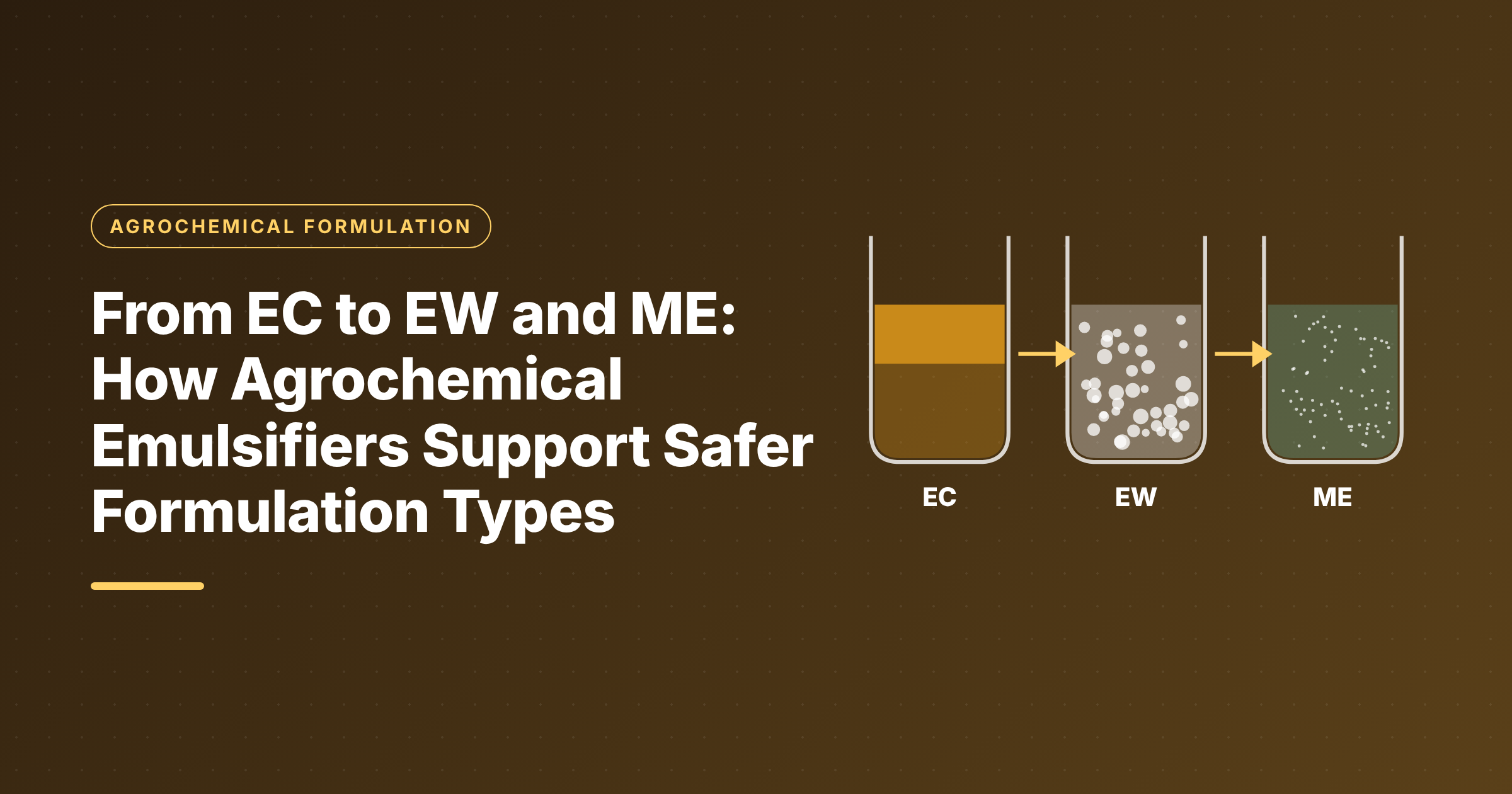
But high solvent loads bring flammability, odour, operator exposure and growing regulatory pressure. That is pushing formulators toward emulsion in water (EW) and microemulsion (ME) formats. Agrochemical emulsifiers sit at the centre of this shift, because each format places very different demands on the surfactant system.
This article walks through how emulsifier choice changes from EC to EW to ME, how to assess an agrochemical emulsifier manufacturer, and what formulation teams should watch for along the way.
Why Formulators Are Moving Beyond EC
EC formulations still have a place. They are easy to make, tolerate a wide range of actives and give good biological performance. Yet several pressures are reshaping the portfolio:
- Solvent safety: Aromatic solvents are flammable and can raise transport and storage classification
- Operator exposure: Solvent vapour and skin contact are concerns for farm workers mixing and spraying
- Regulatory scrutiny: Several co-formulant solvents face restrictions in different markets
- Crop safety: High solvent loads can increase phytotoxicity risk on sensitive crops such as vegetables and fruit
- Odour and handling: Retailers and farmers increasingly prefer lower-odour products
The answer is not to abandon oil-soluble actives. It is to deliver them with less solvent and more water, which is where EW and ME formats come in.
Agrochemical Emulsifiers in EC Formulations
How an EC works
An EC contains the active, a water-immiscible solvent and an emulsifier package, typically 5–10% of the formula. When diluted in the spray tank, it spontaneously forms an oil-in-water emulsion.
Typical emulsifier system
Most EC emulsifier packages pair an anionic and a nonionic surfactant:
- Calcium dodecylbenzene sulfonate (CaDDBS): The classic anionic, providing fast spontaneity and hard-water tolerance
- Castor oil ethoxylates: Flexible nonionics that cover a wide HLB range
- Tristyrylphenol ethoxylates: Strong emulsifiers for difficult actives and solvents
- EO/PO block copolymers: Improve emulsion stability and reduce foam
The anionic-to-nonionic ratio is tuned to the solvent and active. A blend that works with an aromatic solvent may fail with a vegetable-oil-based solvent.
Key EC tests
- Spontaneity of emulsion in standard hard and soft waters
- Emulsion stability and re-emulsification after 2 and 24 hours
- Cold storage for crystallisation of the active
- Accelerated heat storage
Agrochemical Emulsifiers in EW Formulations
What an EW is
An emulsion in water (EW) is a concentrated oil-in-water emulsion. The active, dissolved in a small amount of solvent or used as a liquid, is pre-emulsified into water with surfactants and stabilisers. Solvent content drops sharply compared with an EC.
EW formats are common for pyrethroid insecticides such as lambda-cyhalothrin, as well as several herbicides and fungicides.
What changes for the emulsifier
In an EC, the emulsifier only needs to form an emulsion briefly in the spray tank. In an EW, it must keep the emulsion stable in the pack for two years or more. That is a much harder job.
EW emulsifier systems usually lean on:
- Polymeric surfactants, such as EO/PO block copolymers and comb polymers, for long-term steric stabilisation
- Tristyrylphenol ethoxylates and their phosphate or sulfate salts for strong interfacial anchoring
- Thickeners such as xanthan gum to slow creaming
- Antifreeze agents such as propylene glycol for cold climates
Practical scenario: an insecticide EW that creams in storage
A pyrethroid EW passes initial tests but shows a clear water layer at the bottom after three months in a hot warehouse. Droplet size has grown.
The root cause is often Ostwald ripening or coalescence. Switching part of the emulsifier to a higher molecular weight polymeric surfactant and adding a small amount of a highly insoluble oil to the dispersed phase typically slows droplet growth.
Agrochemical Emulsifiers in ME Formulations
What an ME is
A microemulsion (ME) is a thermodynamically stable, transparent mixture of oil, water and surfactant. Droplets are very small, typically below 100 nanometres, so the product looks clear.
MEs suit actives that need good penetration and a clear product appearance. Triazole fungicides such as propiconazole are among those offered in ME formats.
What changes for the emulsifier
MEs need high surfactant loads, often 15–30% or more, sometimes with co-surfactants such as short-chain alcohols or glycols. The emulsifier system must:
- Produce a single clear phase across the full storage temperature range
- Stay clear on dilution or form a fine, stable emulsion in the spray tank
- Avoid causing excessive foam or phytotoxicity at high surfactant loads
Common building blocks include fatty alcohol ethoxylates, CaDDBS, castor oil ethoxylates and alkyl polyglucosides, blended carefully to hit the narrow phase window.
The temperature trap
MEs are sensitive to temperature because nonionic surfactant solubility changes with heat. A formula that is clear at 25 °C may turn cloudy at 45 °C or separate at 0 °C. Mapping the phase diagram across real storage temperatures is essential, especially for hot-climate markets.
EC vs EW vs ME: Practical Selection Checklist
Work through these questions before choosing a format:
- What is the active’s physical form and solubility? Low-melting or liquid actives suit EW. Actives with moderate solubility in a co-solvent may suit ME.
- How much solvent can you remove? EW typically needs the least solvent; ME needs some co-solvent plus higher surfactant.
- What is the cost target? ME surfactant loads raise cost. EW needs polymeric stabilisers and careful processing.
- What storage conditions apply? Hot regions require proven stability at elevated temperatures.
- What equipment do you have? EW often needs high-shear homogenisers; ME can form with simple mixing.
- What does the crop need? Sensitive crops may favour lower-solvent EW over EC.
- What is the regulatory path? A format change may need new data for registration in your market.
Common Mistakes and How to Avoid Them
- Copying an EC emulsifier blend into an EW. Short-term emulsifiers rarely give long-term pack stability. Redesign the system around polymeric stabilisers.
- Underestimating ME surfactant cost. Plan cost targets early, before committing to an ME route.
- Testing only at 25 °C. Run storage at low and high temperatures, plus freeze-thaw cycles.
- Ignoring tank-mix behaviour. An EW or ME that is stable in the pack may break when mixed with other products. Test common tank mixes.
- Forgetting about biological efficacy. Changing format can change uptake and performance. Run field trials, not just lab stability tests.
How to Evaluate an Agrochemical Emulsifier Manufacturer
Moving from EC to EW or ME raises the bar for the surfactant system, and for the people who supply it. An agrochemical emulsifier manufacturer that only offers ready-made EC blends may not have the polymeric stabilisers or microemulsion know-how that newer formats need.
When shortlisting a pesticide emulsifier manufacturer or surfactant supplier for agrochemicals, check:
- Breadth of chemistry: Calcium dodecylbenzene sulfonate, castor oil ethoxylates, tristyrylphenol ethoxylates, EO/PO block copolymers and alkyl polyglucosides from one source make system design easier
- Ready blends and building blocks: Pre-paired EC emulsifier blends save time; individual components give you control for EW and ME work
- Specification and consistency: Active content, ethoxylation degree, water content and multi-batch data, since small shifts change emulsion spontaneity
- Solvent compatibility data: Performance with aromatic solvents, methylated seed oils and fatty acid dimethylamides
- Formulation support: Lab help with emulsion stability, phase mapping for ME and storage studies for EW
- Regulatory documents: Co-formulant status, safety data sheets and data packages that support registration in your markets
- Supply reliability: Lead times, regional stock and capacity, especially during peak crop seasons
Formulators in India and other major crop protection markets often run parallel trials with two EC emulsifier suppliers. It is the fastest way to find a robust system and keep a backup ready.
FAQs on Agrochemical Emulsifiers
What is the difference between EC, EW and ME formulations?
An EC is an oil-based concentrate that forms an emulsion only when diluted. An EW is a ready-made, concentrated oil-in-water emulsion with much less solvent. An ME is a clear, thermodynamically stable microemulsion with very small droplets. EW and ME formats generally reduce solvent content and improve handling safety.
Which emulsifiers are used in EC formulations?
EC formulations typically combine an anionic emulsifier, most often calcium dodecylbenzene sulfonate, with nonionic emulsifiers such as castor oil ethoxylates, tristyrylphenol ethoxylates or EO/PO block copolymers. The ratio is tuned to the solvent and active so the concentrate emulsifies quickly and stays stable in both hard and soft water.
Why are EW formulations considered safer than EC?
EW formulations replace most of the organic solvent in an EC with water. This lowers flammability, reduces solvent vapour and skin exposure for operators, and can reduce phytotoxicity on sensitive crops. Lower solvent content can also simplify transport and storage requirements, depending on local classification rules.
Why do microemulsions need so much surfactant?
Microemulsions form extremely small droplets, which creates a very large oil–water interface. Enough surfactant is needed to cover that interface completely and keep the system in a single, clear phase. Co-surfactants such as glycols or short-chain alcohols are often added to widen the stable temperature range.
Can any EC be converted to an EW?
Not every EC converts easily. Actives that are solid at room temperature, highly water-soluble or prone to hydrolysis can be difficult to formulate as EWs. Conversion usually needs a redesigned emulsifier system with polymeric stabilisers, a homogenisation step and full stability testing before registration.
How do I choose an agrochemical emulsifier supplier?
Choose a supplier offering a broad range of anionic, nonionic and polymeric emulsifiers, including CaDDBS, castor oil ethoxylates and EO/PO copolymers. Look for consistent multi-batch quality, solvent compatibility data, hands-on support for EC, EW and ME development, complete regulatory documentation and dependable supply during peak crop seasons.
Conclusion: Let the Emulsifier Lead the Format Decision
Agrochemical emulsifiers are no longer just helpers that make an EC turn milky. They decide whether an EW survives two summers in a warehouse and whether an ME stays clear from a cold winter morning to a hot afternoon.
A practical next step for formulation teams: list your top five EC products by volume and score each one against the selection checklist above. The ones with liquid actives, sensitive crops or solvent-related complaints are usually the best candidates to move to EW or ME first.