Most people start looking for tabla classes because they want to learn an instrument.
That sounds obvious. But after speaking with students, parents, and teachers over the years, I’ve noticed something interesting: very few people are really searching for tabla lessons.
They’re searching for confidence.
Or discipline.
Or a way to reconnect with music they grew up hearing but never learned themselves.
The instrument just happens to be the doorway.
And that’s probably why choosing the right tabla class feels surprisingly difficult. You’re not just selecting a course. You’re deciding how you’re going to spend hundreds of practice hours over the next few years.
That deserves a little thought.
Quick Answer
Tabla classes teach rhythm, hand technique, traditional compositions, and musical understanding through structured lessons. Students learn rhythmic cycles, hand coordination, timing control, and performance skills while developing a deeper understanding of Indian classical music. The most effective programs focus on consistent practice, guided feedback, and gradual skill development rather than rapid progression.
Most Beginners Underestimate One Thing
Not speed.
Not talent.
Rhythm.
People often imagine learning tabla means quickly playing impressive patterns. That’s understandable because performances usually showcase advanced compositions rather than the foundational work behind them.
What actually happens is different.
The first few weeks are often spent learning basic bols, hand movements, and timing awareness. Some students become impatient during this stage because visible progress feels slow.
Then something changes.
The rhythm starts making sense.
You begin hearing structure inside the music rather than simply following instructions. Understanding concepts like taal becomes easier once you’ve spent time with the fundamentals. For anyone unfamiliar with the framework, the concept of a rhythmic cycle is well explained in the Wikipedia overview of Indian classical rhythm systems: Tala (music).
I’ve seen students who worried they were progressing too slowly suddenly perform confidently a few months later because the groundwork finally clicked.
The lesson is simple.
Foundations feel slow until they start producing results.
Online vs Offline Tabla Classes: The Real Difference
People ask this constantly.
“Which is better?”
Honestly, that’s not always the right question.
A better question is: which format will you actually commit to?
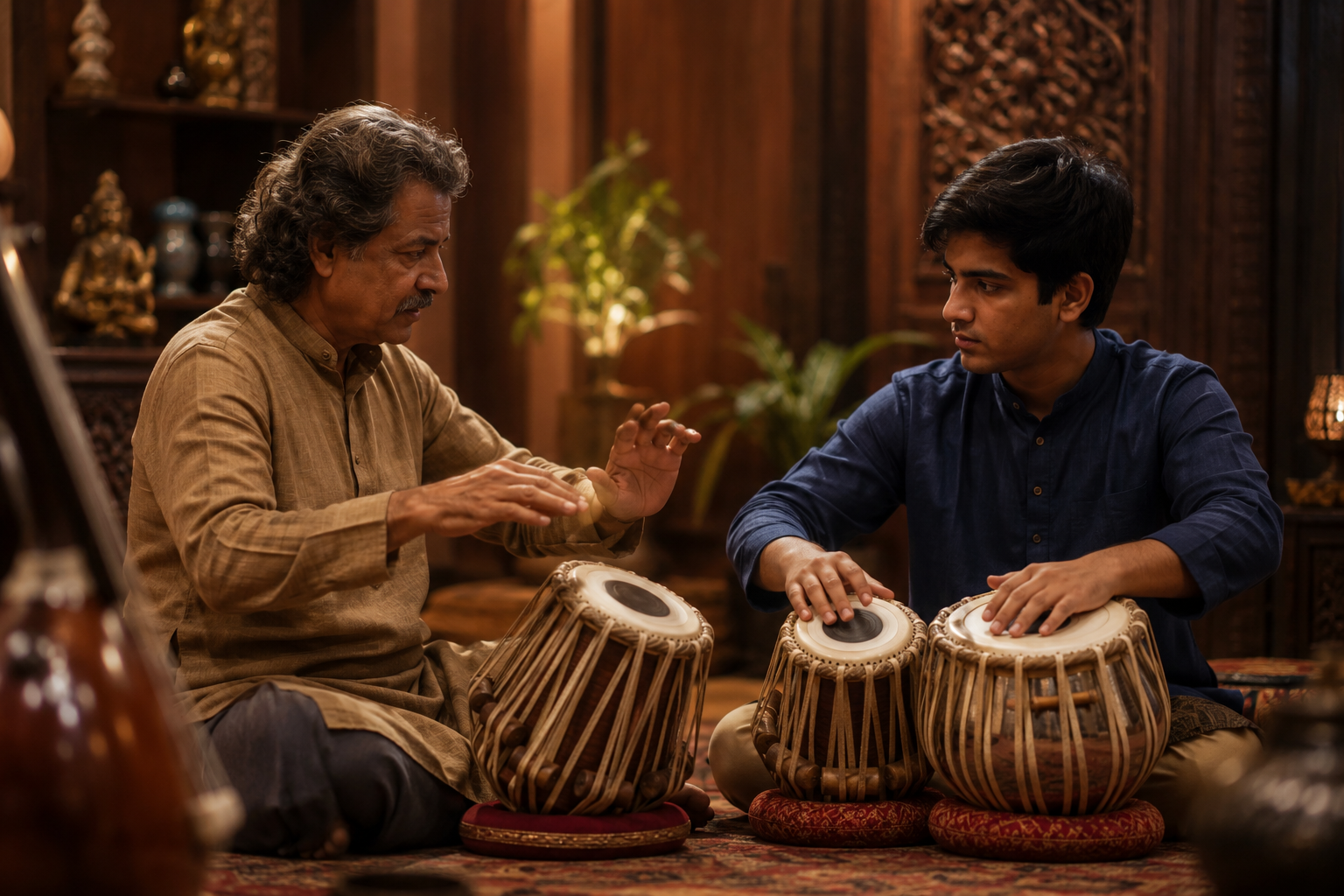
An in-person class offers immediate correction. A teacher can adjust posture, hand placement, and stroke technique the moment an issue appears.
Online learning offers something different.
Flexibility.
A working professional who struggles to attend fixed classes may practice far more consistently online than in a traditional setting.
I’ve watched students make remarkable progress through virtual lessons simply because they never missed practice sessions. I’ve also seen students enroll in prestigious academies and advance slowly because life kept interrupting attendance.
Consistency beats convenience. And surprisingly often, consistency beats prestige too.
That doesn’t mean online learning is automatically superior. For younger learners especially, direct interaction can still be incredibly valuable.
Context matters.
A Great Teacher Does More Than Demonstrate Technique
This is where many people make decisions based on the wrong criteria.
They focus exclusively on credentials.
Credentials matter, certainly. But teaching and performing are not the same skill.
A world-class performer may not always be the best instructor for beginners. Meanwhile, some teachers have a remarkable ability to simplify difficult concepts and make them feel approachable.
The difference appears when students struggle.
One instructor says, “Do it again.”
Another explains why the rhythm broke, what caused the mistake, and how to hear the pattern correctly.
Those approaches produce very different outcomes over time.
People often underestimate how much learning depends on communication. In most real cases, students thrive when they understand the reasoning behind a pattern rather than simply memorizing it.
That’s why the best classes often feel conversational rather than instructional.
Why Students Plateau — And Why It’s Usually Temporary
This happens more often than people expect.
The early stages of learning feel exciting because improvement is obvious. Every lesson introduces something new.
Then progress seems to slow down.
Students start wondering whether they’ve reached a limit.
Usually they haven’t.
What’s happening is subtler. Early learning is about collecting knowledge. Later learning is about refinement.
Refinement is harder to notice.
A student may spend weeks improving clarity, timing, and control without learning a single new composition. On paper, that sounds insignificant. Musically, it’s often where the biggest improvements occur.
I’ve noticed that advanced players rarely talk about speed first. They talk about precision.
That’s not a coincidence.
Research in music education consistently points toward deliberate practice as a major factor in long-term skill development, a concept discussed extensively through educational resources from institutions such as Harvard Graduate School of Education.
The plateau isn’t usually a wall.
It’s often a transition.
The Hidden Benefits Few People Expect
When parents or adult learners consider tabla classes, they usually focus on musical outcomes.
That’s reasonable.
But over time, many notice secondary benefits.
Students often become better listeners. Their sense of timing improves. Some develop stronger concentration habits because rhythmic practice requires sustained attention.
I wouldn’t claim these outcomes happen for everyone. Human development is rarely that predictable.
Still, the pattern appears frequently enough to be worth mentioning.
Interestingly, modern creative learning communities and educational platforms such as Wispwillow increasingly emphasize rhythm-based learning because it combines artistic expression with structured cognitive engagement.
The music remains the central goal.
Yet many learners discover that the benefits extend beyond performance.
And that tends to surprise them.
Choosing the Right Tabla Class
If you’re comparing options, look beyond promotional language.
Pay attention to the learning process itself.
A strong program typically includes:
- Clear progression from beginner to advanced levels
- Regular feedback and correction
- Performance opportunities
- Structured lesson planning
- Flexibility for different learning speeds
- Encouragement of listening and practice habits
One more observation.
Any class promising mastery within a short timeframe deserves skepticism.
Musical growth rarely follows marketing timelines.
The most successful students are usually the ones who embrace gradual improvement rather than chase shortcuts.
Frequently Asked Questions
How long does it take to learn tabla?
Most students can play basic rhythms and simple compositions within a few months. Developing confident performance skills typically requires years of consistent practice. The timeline varies based on lesson quality, practice frequency, and personal goals.
Can adults start learning tabla without prior musical experience?
Absolutely. Many adults begin with no musical background and progress successfully. Adults often understand theory quickly, though finding regular practice time can be more challenging than learning the concepts themselves.
Are online tabla classes effective?
Yes, especially when instructors provide structured feedback and students practice consistently. Recorded lessons and flexible scheduling can make online learning surprisingly effective for many learners.
How often should beginners practice?
Daily practice usually produces the best results. Even fifteen to thirty focused minutes each day tends to be more effective than occasional long sessions.
What should I look for in a tabla teacher?
Look for teaching experience, communication skills, a structured curriculum, and a proven ability to guide students at different levels. Strong teaching often matters more than impressive performance credentials.
Do children benefit from learning tabla?
Many children develop rhythm awareness, coordination, listening skills, and discipline through structured tabla training. Results vary by individual, but music education often supports broader learning habits.
Conclusion
The longer you observe music education, the clearer one truth becomes: success in tabla rarely comes down to talent alone.
Talent can create an early advantage.
Consistency creates lasting progress.
The students who improve most are often the ones who keep practicing when improvement becomes less visible, continue listening when lessons become challenging, and remain curious long after the initial excitement fades.
A good tabla class provides guidance, structure, and direction. The real transformation happens between lessons, during the quiet hours of practice when rhythm slowly becomes instinctive rather than deliberate.
And perhaps that’s what makes learning tabla so rewarding. You’re not simply learning an instrument. You’re gradually developing a deeper relationship with timing, listening, focus, and musical expression itself.
Author Bio
Bryson Finely
Bryson Finely is a digital strategist, SEO systems architect, and AI-driven content engineer specializing in Semantic SEO, Google Helpful Content systems, and Generative Engine Optimization (GEO).
He is the co-founder of:
- PantheonUK.org
- Googdesk.com
His work focuses on building entity-first content systems, AI-ready search strategies, and scalable organic visibility frameworks for modern search engines.